
The Difference Between Managing and Leading and Why Coaching Bridges the Gap
The Difference Between Managing and Leading and Why Coaching Bridges the Gap
Somewhere along the way, "manager" and "leader" became interchangeable in most workplaces. They're not the same role, and the gap between them is exactly where coaching does its most important work.
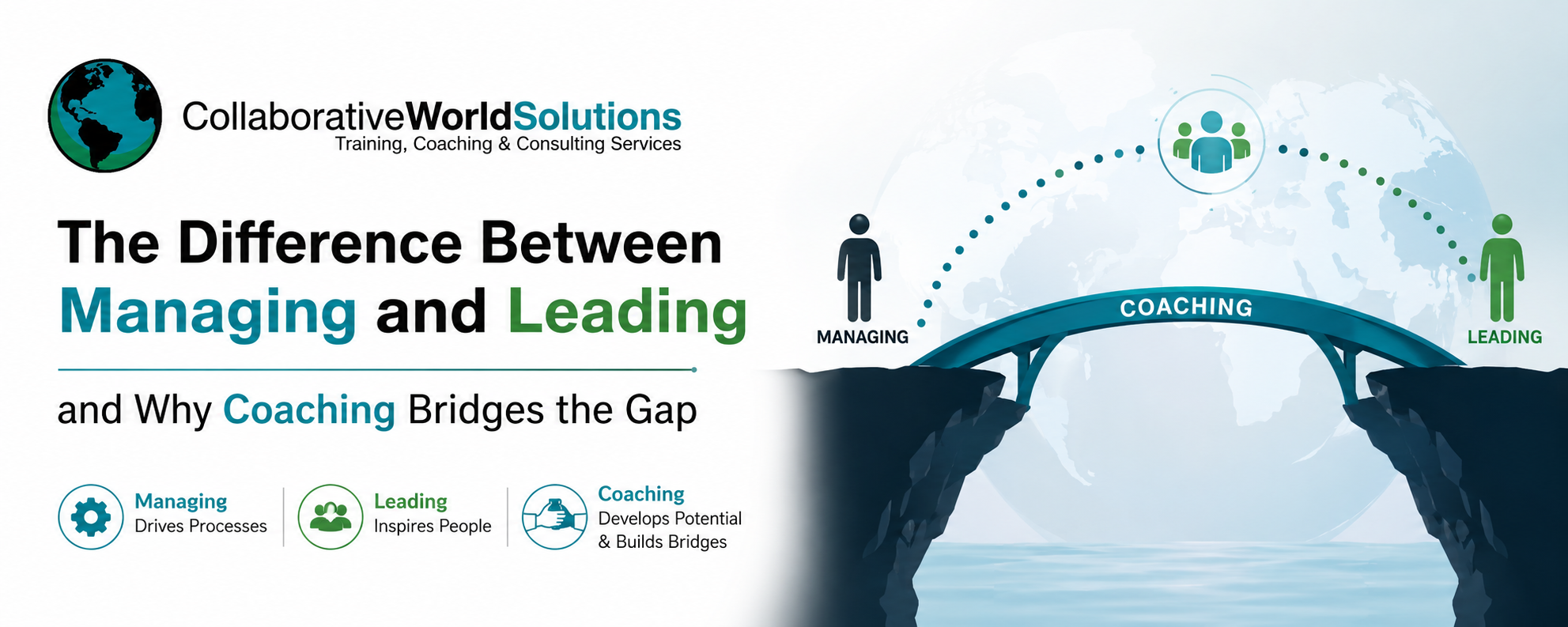
Managing is about the work. Leading is about the people doing the work.
Management is task-oriented by design and it's the discipline of planning, organizing, and tracking execution. It's necessary, and good managers keep organizations functioning. But leadership is a different skill set. It's the ability to build trust, communicate a vision people actually believe in, and create the conditions where people choose to bring their full effort, not just their work obligation.
Someone can be an excellent manager and still struggle to lead. The skills don't automatically transfer, because they're not solving the same problem.
Why this distinction matters more during change
When organizations are stable, the gap between managing and leading can stay hidden and processes carry the weight. But during a reorganization, a leadership transition, or any period of real uncertainty, management alone isn't enough. People aren't looking for a better task tracker in moments like these. They're looking for someone who can hold ambiguity, communicate honestly, and help them see a path forward. That's leadership work, and it's learnable, but it rarely develops through observation alone.
Where coaching fits in
Coaching isn't about fixing what's broken. It's about creating a structured space for a leader to slow down, examine their own patterns, and connect their personal values to how they actually show up. Grounded in International Coaching Federation frameworks, effective coaching asks the questions a busy leader rarely has time to ask themselves:
- What am I optimizing for, and does it match what I actually value?
- Where am I managing out of habit instead of leading with intention?
- What’s the gap between how I think I’m showing up and how my team experiences me?
These aren't abstract questions. They're the starting point for real behavior change and the kind that shows up in how a leader runs their next difficult conversation, not just how they describe their philosophy in a performance review.
The shift coaching makes possible
Leaders who go through sustained coaching engagements don't just get better at managing tasks. They develop the self-awareness to notice their own default patterns in real time, the communication skill to name what's actually happening in a room, and the accountability structure to follow through on the leader they want to be, not just the manager their role requires them to be.
The data backs this up. The International Coaching Federation's Global Coaching Client Study found that companies typically see a median return of roughly seven times their initial coaching investment, and 86% of organizations that tracked ROI at least recovered their costs. On the individual side, 80% of coaching clients report improved self-confidence, and a large majority describe measurable gains in communication and interpersonal effectiveness. None of that happens through observation alone, it happens through deliberate, sustained practice, which is exactly what coaching is designed to support.
That shift, from managing tasks to leading people with intention, is rarely something that happens by accident.
Curious what a coaching engagement built around your specific leadership challenges could look like?
Let’s start the conversation!
Take the first step today! Schedule a coaching or consultation session by clicking on the "Contact Us" tab.
*****************************************************************************************************************************************************************************************************************************************
Citations:
1. International Coaching Federation / PricewaterhouseCoopers, Global Coaching Client Study, as summarized in ICF's "Coaching Statistics: The ROI of Coaching." https://coachingfederation.org/blog/coaching-statistics-the-roi-of-coaching-in-2024/
2. ICF Global Coaching Client Study data, as compiled in Personify, "75 Coaching Industry Statistics 2026." https://personify.fyi/coaching-stats/