
What Happens When People Actually See Each Other's Work
The Case for Job Shadowing Programs and Why Most Organizations Are Missing a Powerful Tool
Most organizations have no shortage of org charts, job descriptions, and performance review templates. What they often lack is something far simpler and far more powerful: a structured way for people to actually see each other's work.
Job shadowing fills that gap. And the research suggests it does so more effectively than most of the formal training programs organizations invest in far more heavily.
What job shadowing actually is and isn't
Job shadowing is observational learning. One employee follows another employee watching how they make decisions, navigate challenges, run meetings, handle competing demands, and build relationships. It is not cross-training, where the shadow performs the tasks. It is not job rotation, where the employee temporarily takes on a different role. It is watching, absorbing, and asking questions in a real workplace environment without the pressure of performing.
That distinction matters. The absence of performance pressure is precisely what makes job shadowing so effective for developing insight and self-awareness. When you're not trying to do the job, you can actually see it.
The engagement crisis that job shadowing can help solve
The 2025 Gallup State of the Global Workplace Report found that only 21% of employees globally are engaged in their work, a figure that cost the world economy $438 billion in lost productivity. In the United States, the number is higher at 31%, but still represents a workforce majority that is either not engaged or actively disengaged.
One of the most consistent drivers of disengagement is the feeling that employees can't see a path forward, that their career feels static, their contribution invisible, or their role disconnected from the larger mission. Job shadowing addresses all three of those dynamics directly, by giving people a visible, living example of what different kinds of work actually look like from the inside.
What the research shows
The evidence for job shadowing programs is increasingly difficult to ignore.
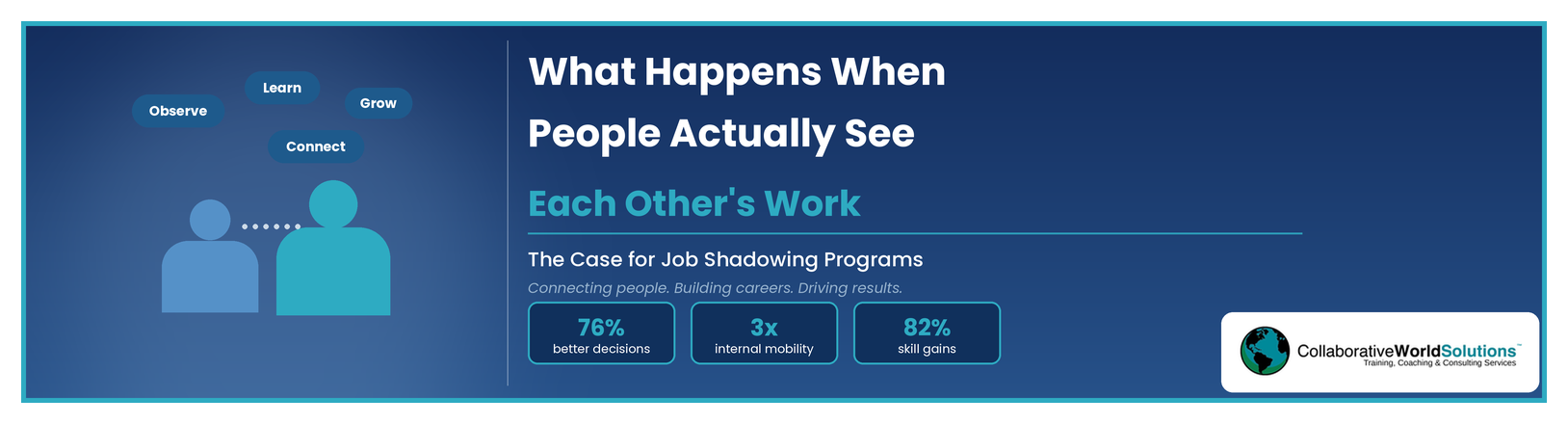
A 2023 study by the National Association of Colleges and Employers (NACE) found that 76% of employees who participated in job shadowing made better career decisions as a result including both those who pursued the shadowed role and those who decided against it. Both outcomes save organizations money by reducing mismatched hires and premature turnover.
LinkedIn's 2024 Workforce Research found that employees who had shadowed another function were three times more likely to pursue internal mobility rather than leaving the organization to find career growth elsewhere. In a talent environment where replacing an employee costs an estimated one to two times their annual salary, that finding alone makes a compelling financial case for job shadowing programs.
A 2022 study by the National Career Development Association (NCDA) found that 82% of participants in job shadowing programs reported significant improvements in practical skill acquisition. And a 2025 study published in Frontiers in Sociology found that participants in structured, Social and emotional learning(SEL)-integrated job shadowing programs established an average of 8.4 new professional contacts and that networking activity showed a moderately strong positive correlation with career growth indicators.
SHRM's 2024 survey found that 68% of organizations already offer job shadowing in some form, making it one of the most widely used and accessible development methods available. Yet very few organizations treat it as a serious, structured investment. Most treat it as informal, optional, and unmeasured which is exactly why most of them are not seeing its full benefit.
The three things job shadowing does that training programs don't
Classroom training and digital learning have their place. But they share a common limitation: they describe work rather than revealing it. Job shadowing does something qualitatively different in three specific ways.
First, it builds organizational understanding that no org chart can replicate. When a marketing manager shadows a product team for two days, she doesn't just learn what that team does she learns the language they use, the trade-offs they navigate, the pressures they're under, and the ways her own work connects to theirs. That kind of contextual understanding accelerates collaboration and breaks down the departmental silos that quietly drain organizational performance.
Second, it surfaces self-awareness in the person being shadowed, not just the person observing. Experienced professionals who host job shadowing experiences consistently report that the experience makes them more reflective about their own habits and decision-making. The act of being observed and explaining your choices to a curious observer is itself a form of professional development.
Third, it directly supports succession planning by giving high-potential employees real exposure to leadership before they step into it. Organizations that use job shadowing as part of their leadership pipeline preparation reduce transition risk, shorten the learning curve for new leaders, and create a more visible and credible pathway to advancement for the employees they most want to retain.
Where coaching makes job shadowing more powerful
Job shadowing creates the raw material for growth. Coaching turns that raw material into sustainable change.
On its own, a job shadowing experience can be clarifying, even transformative. But without a structured space to process what was observed to examine what it surfaced, what it challenged, and what it revealed about the observer's own assumptions and ambitions, the insight often fades before it becomes action.
Post-shadowing coaching create exactly that space. A skilled coach or manager can help a participant move from “I noticed something interesting” to “I understand what it means for where I want to go and how I need to develop to get there.” For organizations building leadership pipelines, that combination of structured observation followed by structured reflection is among the most efficient development investments available.
The International Coaching Federation's Global Coaching Client Study found that companies see a median return of seven times their initial coaching investment, and 86% of organizations that tracked ROI at least recovered their costs. When coaching is layered onto a well-designed job shadowing program, the return compounds: the observation deepens the coaching conversation, and the coaching deepens what the employee takes from the observation.
What a well-designed job shadowing program actually looks like
The organizations that see the strongest results from job shadowing share a few common practices. They define clear objectives before the experience begins whether the goal is career exploration, leadership development, onboarding, or succession planning. They match participants thoughtfully based on learning goals, not just availability. They build in structured reflection, whether through manager debrief conversations, or coaching sessions. They also measure outcomes tracking metrics like internal mobility rates, engagement scores, and promotion rates rather than treating the program as a check-the-box activity.The through-line in all of those outcomes is intentionality. Job shadowing works when it is designed to work and when it is treated as a development strategy rather than an informal perk.
The bottom line
In an environment where employee engagement is at a historic low, where internal talent pipelines are underdeveloped, and where the cost of turnover continues to climb, job shadowing programs represent one of the most accessible and underutilized development levers available to organizations.
They are low-cost relative to formal training. They produce measurable outcomes. They build the organizational understanding that makes teams more collaborative, leaders more effective, and employees more invested in staying.
The question is not whether job shadowing works. The research is clear that it does. The question is whether your organization is treating it with the intentionality it deserves or leaving one of its most powerful development tools sitting largely unused.
Interested in designing a job shadowing program for your team or pairing it with coaching to deepen the impact? Let's start the conversation.
Take the first step & schedule a coaching or consultation session: www.CollaborativeWorldSolutions.com
Citations
1. Gallup. (2025). State of the Global Workplace 2025 Report. As cited in Paycor, '28 Employee Retention Statistics Employers Need to Know.' https://www.paycor.com/resource-center/articles/employee-retention-statistics/
2. National Association of Colleges and Employers (NACE). (2023) research cited, LinkedIn Workforce Research. (2024), data cited, and Society for Human Resource Management (SHRM) (2024) survey data cited in Hyring, 'Job Shadowing: What It Is, Benefits and How to Set It Up.' https://hyring.com/free-hr-toolkit/hr-glossary/job-shadowing
3. National Career Development Association (NCDA). (2022). Study cited in Workable, 'Job Shadowing at Work — How Can It Benefit Your Organization?' https://resources.workable.com/stories-and-insights/job-shadowing-how-it-can-benefit-your-organization
4. Margeviča-Grinberga, I., et al. (2025). 'Job Shadowing Adults' Non-Formal Education Programme Through Social-Emotional Learning.' Frontiers in Sociology. https://www.frontiersin.org/journals/sociology/articles/10.3389/fsoc.2025.1524922/full
5. International Coaching Federation / PricewaterhouseCoopers. Global Coaching Client Study, as cited in ICF's 'Coaching Statistics: The ROI of Coaching in 2024.' https://coachingfederation.org/blog/coaching-statistics-the-roi-of-coaching-in-2024/