
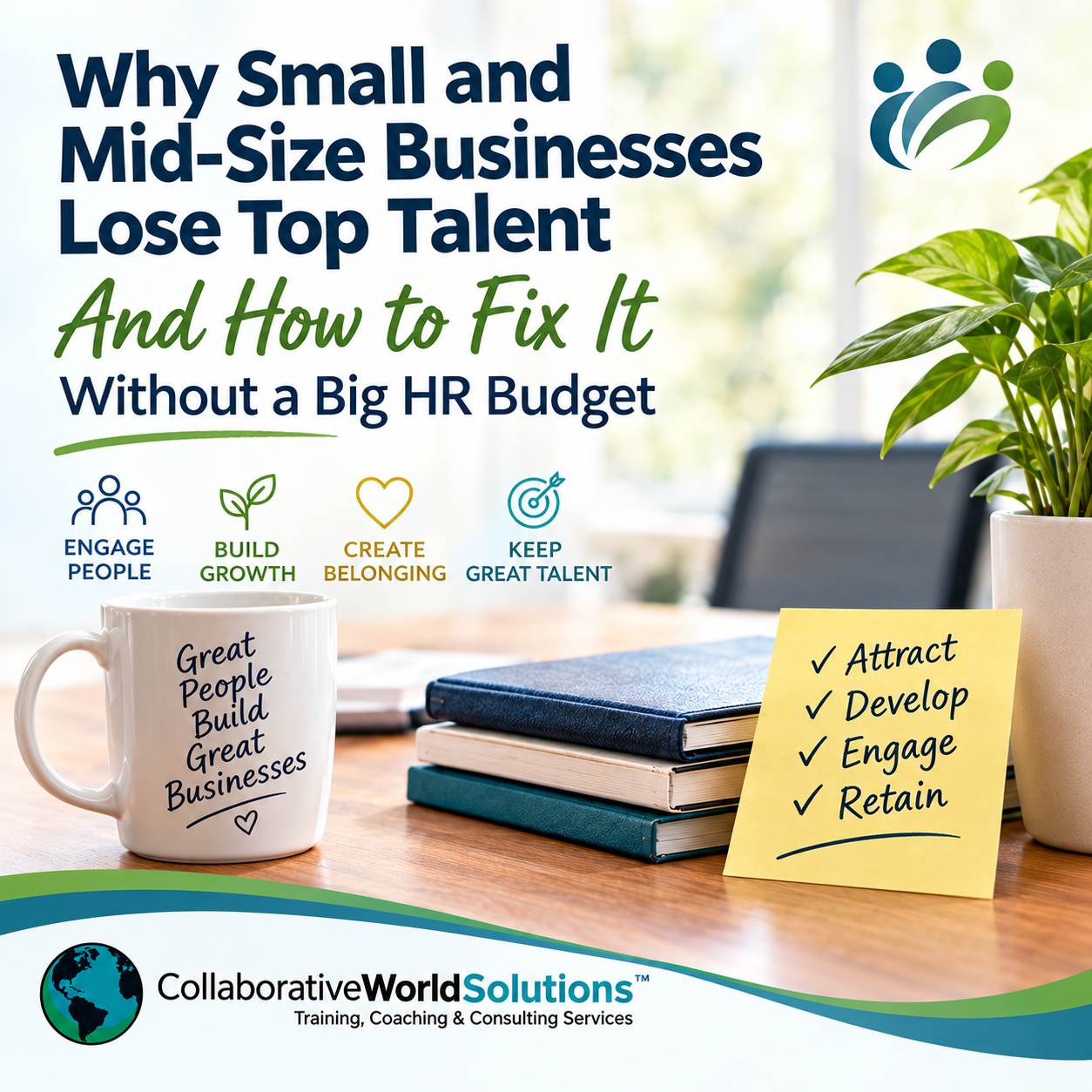
Why Small and Mid-Size Businesses Lose Top Talent And How to Fix It Without a Big HR Budget
Large enterprises lose talent too, but they can absorb it deep benches, big recruiting budgets, and often have established employer brands. Small and mid-size businesses don't have that cushion. When a strong performer walks out the door, it's felt immediately: in output, in morale, especially in the workload that lands on everyone else.
The good news is that most talent loss at smaller to mid-size organizations isn't caused by what people assume, pay. It's caused by a handful of fixable, structural gaps.
It's rarely just about compensation
Pay matters, but exit interviews across industries consistently point to the same underlying themes: lack of growth path, unclear expectations, feeling undervalued, and poor manager relationships. That adds up fast and Gallup estimates that replacing an employee costs somewhere between 50% and 200% of their annual salary once recruiting, training, and lost productivity are factored in, and Gallup puts the total cost of voluntary turnover to U.S. businesses at roughly $1 trillion a year (McFeely & Wigert, 2019).1 The Work Institute's 2025 Retention Report goes further, estimating that 75% of voluntary exits were actually preventable (Work Institute, 2025).² A competitive salary buys you a starting point but it doesn't buy loyalty, and it definitely doesn't buy engagement.
The four gaps that quietly drive people out
1. No visible growth path. Even strong performers disengage if they can't see where the next two years lead. Smaller organizations often assume they can't offer growth without a big promotion ladder but growth can mean expanded scope, new skills, exposure on different projects, or mentorship which are not just a title change.
2. Inconsistent onboarding. First impressions set the tone for tenure. When onboarding is informal or manager-dependent, new hires form early doubts about whether the organization is actually organized and those doubts are hard to reverse. Research from the Brandon Hall Group found that a strong, structured onboarding process improves new-hire retention by as much as 82% and productivity by more than 70% (Lau, 2025). ³
3. Manager capability gaps. Most managers at growing companies were promoted for being good individual performers, not for being trained leaders. Without support, even well-intentioned managers can create the exact disengagement they're trying to prevent (Gallup, 2026). 4
4. Culture that isn't actively maintained. Culture doesn't stay strong by accident once a company grows past the founding team. It requires deliberate reinforcement, otherwise it drifts, and people notice the drift before leadership does.
A simple framework: Attract, Develop, Engage, Retain
Strong talent strategy isn't a single initiative, it's a connected system:
- Attract: Is your hiring process actually reflecting the culture candidates will experience once they join?
- Develop: Do people have a clear, visible path to grow their skills and scope?
- Engage: Do employees understand how their work connects to something bigger than their task list?
- Retain: Are you addressing the structural reasons people leave, not just reacting after they've already decided to go?
Each stage reinforces the others. A strong attraction process means nothing if development stalls. Strong development means little if engagement is low. The organizations that retain talent well tend to treat these as one connected strategy, not four separate HR line items.
You don't need a large budget. You need the right strategy
Talent strategy consulting for a 40 to 800-person company looks nothing like talent strategy for a 4,000-person enterprise, and it shouldn't. The most effective approach for small to mid-size organizations is targeted: identify the one or two structural gaps actually driving turnover, and solve those first, rather than importing a large-company HR framework that doesn't fit your size or culture.
If turnover has been creeping up and you're not sure why, take the first step , a conversation about your specific context is often where the clearest answers show up.
Take the first step & schedule a coaching or consultation session: www.CollaborativeWorldSolutions.com
____________________________________________________________________________________
Citations:
McFeely, S., & Wigert, B. (2019, March 13). This fixable problem costs U.S. businesses $1 trillion. Gallup. https://www.gallup.com/workplace/247391/fixable-problem-costs-businesses-trillion.aspx
Work Institute. (2025). 2025 retention report: Employee retention truths in today's workplace. https://info.workinstitute.com/hubfs/2025%20Retention%20Report/2025%20Retention%20Report%20-%20Employee%20Retention%20Truths%20in%20Todays%20Workplace.pdf
Lau, G. (2025, October 13). 25 surprising employee onboarding statistics in 2026. StrongDM. https://www.strongdm.com/blog/employee-onboarding-statistics
Gallup. (2026). State of the global workplace: 2026 report. https://www.gallup.com/workplace/349484/state-of-the-global-workplace.aspx